Automated document processing software for converting scanned documents, PDF files, Office documents and other formats to editable text or structured data that can be exported to CSV, XML, JSON or SQL databases.

Simple Software

SimpleIndex can bring speed and efficiency to your scanning or doc filing no matter the process. Even if all you are doing is hand keying a few basic details about a document, breaking those details into individual indexes and adding tools like drop down choice lists, automatic orientation, and blank page deletion ensure a smoother, more consistent process.

Automation

Here’s where things start to get interesting. From basic tasks like splitting individual documents within at stack of pages by spotting a blank page, a specific mark, or a barcode separator to capturing index data directly from the page or looking up additional details about a document in a database, SimpleIndex has a host of powerful tools to tame your piles of paper or drives full of digital files. Let’s look at a few.

OCR

Optical Character Recognition is the ability to take a scan, which is merely a picture of a page, and turn it into words that the computer can understand and use to index your files. SimpleIndex leverages the power of ABBYY FineReader, recognized as one of the best OCR engines on the market, to accurately capture names, dates, important numbers, document types, and other details about your file. Some products have you set a box and capture whatever information happens to fall in that zone. SimpleIndex takes it further with Dynamic Zone OCR to enable you to set an oversized zone that allows for shifting of the pages between scans, but still captures just the date you need by matching against templates, lists, or even Regular Expressions (RegEx). You can also skip the zones entirely and use the full text of a page to find matches for your index data.


Barcodes

Forms Processing

What is ICR, Survey & Forms Processing?

ICR stands for Intelligent Character Recognition and is the technology that allows software to interpret hand printed text on scanned images.

Data Capture Forms OCRForms Processing Software uses ICR technology to automate data entry tasks involving hand-filled surveys, applications and forms. It provides interfaces for scanning, recognition, data verification and export, as well as management and monitoring tools to track large volumes of documents and data through the workflow.
Forms Processing also includes OCR (Optical Character Recognition) technology to recognize machine printed text, and OMR (Optical Mark Recognition) for check boxes and multiple choice bubbles.

It is also possible to use these applications to automate data collection from PDF forms, Word documents, Excel spreadsheets, and other formats used to fill out forms electronically. Many include the ability to publish forms as paper, fillable PDF and web pages simultaneously to distribute and collect data from multiple sources into one dataset.

Who can benefit from forms processing software?

Any organization that collects data on paper-based forms, surveys or applications on a regular basis can get a very high return on investment by automating the data entry with forms processing software.

You do need to have a significant number of forms to justify the expense– at least a hundred forms per month or more depending on how much data is being captured. If the data entry task can be done in under 100 man-hours then it is not a good candidate for automation with ICR software.

Organizations that have many separate departments that collect data on forms can share the budget for forms processing software by re-using it for other projects. Your current project may not be big enough to justify the expense, but when combined with one or two others it would be.

How much do […]

Document Management

Simple Document Management SystemsDocument management covers a lot of ground, from a shared folder of scanned files to a records system with audit trails and retention rules.

Whichever one you need, the step that decides whether it works is the first one: getting paper in as searchable, indexed documents instead of flat images nobody can find.

We sell both halves. Capture and OCR software indexes documents on the way in, and document management systems store, search, share and route them. We can also add OCR to the system you already run.

Contact us for a free evaluation of your project and a live demo of the software we recommend.

Small Offices and Departments

For one department or a small business, a well-organized shared folder is often all the document management you need. Batch scanning software like SimpleIndex reads barcodes and text as it scans, then names and files each document automatically, so a shared folder or SharePoint library stays searchable without anyone typing.

Desktop document management adds a viewer, search and simple organizing on top, without the security and workflow overhead of an enterprise system.

Cloud or On-Premise

A web-based system works from any computer without installing client software. A hosted one also takes the servers and upgrades off your hands.

Both of the enterprise platforms we recommend come in on-premise and cloud versions:

Records Management for Larger Organizations

Once more than a handful of people share documents, you usually need more than storage and search:

  • Access […]

Document Scanning

Document scanning software: the whole run, not just the recognition step

Feeding paper into a scanner is the easy part. What costs money is everything around it — deciding where one document ends and the next begins, straightening and cleaning the images, reading enough of each page to name and file it, checking the result, and handing it to whatever system has to hold it. A document capture platform is software that runs that sequence over a batch, unattended, and only asks for a person when something genuinely needs one.

A batch, end to end

  • Scan or import. TWAIN and ISIS scanners, watched folders, email or files already on disk — existing images are treated the same as fresh paper.
  • Separate. Barcode sheets, patch codes, page counts or a recognised value tell the software where each document starts, so a stack goes through in one pass instead of one job per file.
  • Clean up. Deskew, despeckle, crop, drop blank pages and convert to bitonal, because recognition accuracy is mostly decided before the OCR engine sees anything.
  • Recognise and index. Full-page OCR makes the document searchable; zone, barcode and AI extraction pull the handful of values that become the filename, the folder path and the database record.
  • Validate. Check a value against a database or a rule, and route only the exceptions to a person rather than having someone watch every page.
  • File and export. Searchable PDF, TIFF or text into an ECM system, a shared folder, SharePoint or a line-of-business application, with the index data written alongside as CSV, XML or a database row.

Where hybrid OCR fits, and why it matters to the bill

Indexing used to mean a template for every layout and a person fixing what the template missed. The platforms below now read the page with a conventional OCR engine on your own hardware first, […]

OCR Servers

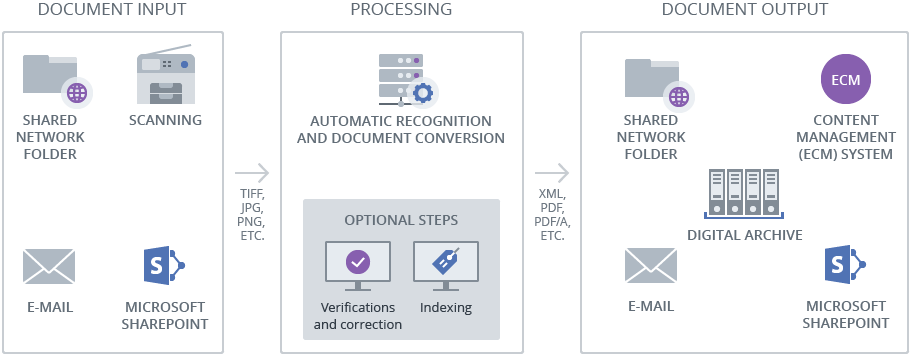
Enterprise OCR servers let you perform Optical Character Recognition on thousands of documents at a time, scaling to meet the demands of the largest document conversions.

Traditional Desktop OCR applications require a person to load the scanned document, run the OCR process and save the output files. This makes sense when you are converting individual documents, but large organizations with thousands or millions of documents need something much more automated and scalable.

OCR Server processing workflow

Typical Enterprise OCR Applications

As the cost of OCR software and hardware goes down each year and the quality goes up, full-text search is included in more and more records management applications. Typical applications include:

Features of Enterprise OCR Servers

  • OCR is performed in the background without a user interface
  • Files are imported automatically from hotfolders
  • Ability to use multiple CPUs and servers for processing
  • Management tools for remote administration
  • Web service & API integration to submit OCR jobs

What is the Best OCR Server?

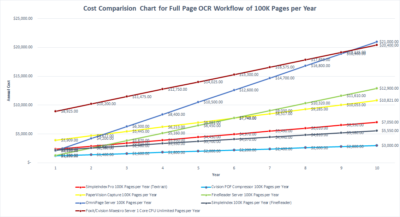
The ABBYY FineReader Server offers the best combination of features, performance and pricing. It has flexible licensing, including an unlimited CPU-based license that does not limit the number of pages processed.

Foxit PDF Compressor has the lowest entry level pricing, OmniPage OCR and unique PDF compression technology that can dramatically reduce the size of searchable PDF documents, leading to faster viewing and lowered cloud storage and bandwidth costs.

The SimpleIndex Server offers affordable unattended OCR services coupled with advanced data extraction and indexing capabilities that organizes documents automatically or saves metadata to Excel or a SQL database. It doesn’t have the scalability, API interfaces or compression technology that other OCR servers have, but you can bundle the Standard Server version with them to add […]

Convert Scanned Image to Text Document

The primary purpose of Optical Character Recognition is to quickly and automatically convert scanned images of machine-printed (typed) text – which to a computer are no more meaningful a collection of pixels than any other image, such as a landscape photo – into actual text data that you can search through and modify.

OCR Software comes in many different types, which vary in price range based on their features, speed, and accuracy. One of the main qualities that OCR producers are using to differentiate their products is volume of the documents OCR will allow you to process. That may be a bit counter intuitive but features that are needed to process hundreds, thousands or millions pages a year are rather different ones.

In case of several hundreds of pages (receipts, checks, medical, tax or legal forms, personal memorabilia)  you need to scan for personal use you would need light, highly versatile, easy to use, not expensive software that will convert images just to text. It may not have automation features, and processing data further will be done manually by you. Thou it is not too hard since volume of documents is not very large and you can treat each of them individually.

Small business users usually process thousands of pages a year and require some automation features. Images need to be converted not just to text, but also to spreadsheets to be processed further. Once the system is set up it is assumed that it will run without much of the interference, and people in charge of document processing would be able to do that with certain ease.

Larger companies processing millions of documents require much larger levels of automation when each small, fine tuned feature would save thousands of work hours in a long run. Multiple machines will be processing documents […]

Applications

Why do I need OCR?

Optical Character Recognition (OCR) is a technology that converts typed, handwritten, or printed text from scanned documents and images into editable, searchable machine-readable data. Without OCR, a scanner simply takes a digital photograph of a page. Because the text in a standard image cannot be searched, copied, or modified, the data remains locked. OCR software solves this by analyzing the shapes of characters in an image and translating them into actual text that other software applications can read and process.

There is a wide variety of OCR software available. While they all share the ability to convert images of machine printed (not handwritten) text or numbers into an editable format, the various software often have different features, accuracy, prices, and language options.

You can find the various types of OCR software with a description of each below.

Users within a single department, working from home or who have a small business can simply scan their documents to a folder that is shared to everyone. In this “ad-hoc” scenario you only need some basic document scanning software to simplify and bring consistency to your filing system.

If you want to move to the next level, there are Desktop Document Management options that provide an all-in-one means for capture, storage, search and retrieval of documents. Additionally, they provide security, advanced capabilities and ease of use above that of the ad-hoc methods

And let’s not forget cloud-based options that alleviate the need to maintain storage servers or keep software up to date.

Need a simple, no frills OCR solution without spending hundreds of dollars on a professional software package? Look no further. There is a no cost, […]

2026-10-03T15:36:32-04:00Tags: , , , , , , , , , , , , , , , , , , , , , , , , , , , , , , , , , , , , , , , , , , , , , , , , , , , , , , , , , , , , , , , , , , , , , , , |
Go to Top