Knoxville, Tennessee based Simple Software provides advanced OCR and data capture solutions for companies around the world, but also right here at home!

Our specialties include optical character recognition (OCR) for machine print documents, intelligent character recognition (ICR) for handwriting recognition, forms processing and survey processing, healthcare claims forms, accounts payable invoice processing, OCR SDK and API integrations for adding character recognition to apps and websites, and robotic process automation (RPA) using UiPath to provide artificial intelligence (AI) and machine learning tools that allow non-programmers to implement workflows on their own.

PDF Processing with FineReader and FineReader Server

How to create a PDF from Microsoft® Word, Excel, or PowerPoint


How to convert emails to PDF


How to Split a PDF

Create new PDF documents or separate PDF documents combined in one easily with FineReader PDF 15.

Learn how to split PDFs and extract pages easily.


How to create and edit interactive PDF forms

Watch this video and see how to edit and create interactive PDF forms quickly and easily.

Form Editor tool in FineReader PDF 15 allows creating and editing fillable PDF forms with text and date fields, dropdown lists, list boxes, checkmarks, radio buttons, signature fileds and action buttons. Collect information and create effective document templates with ease!


How to extract text from scanned PDFs


How to extract tables


How can I verify if the digital signature is valid?

If you open a document with a valid digital signature in FineReader, you will see a green notification Valid on the left panel of ABBYY FineReader PDF 15:
 mceclip0.png

Recognizing a document with existing text layer in FineReader PDF 15

  1. Open FineReader PDF 15;
  2. Go to Tools > Options > OCR;
  3. In the PDF recognition mode select Use OCR option:​
  4.  Click OK;
  5.  Recognize your document again.


How to convert a document into an accessible PDF/UA

Make your mixed documents—PDF, scanned, photographed, or papers— digital and accessible.

In this […]

Using ABBYY Vantage Document Skills

Processing Your First Documents with Vantage

Learn how easy it is to get started with Vantage – upload your documents and Vantage will take care of the rest.


How to Create and Train a Vantage Document Skill

Learn how to use the Vantage Skill Designer to create and train a new Document Skill with just a few sample documents.


How to Create and Train a Classification Skill in ABBYY Vantage

Learn how to use the Vantage Skill Designer to train a new Classification Skill. You need just a few samples of each document class.


How to Automate a Complete Workflow, by Creating a Vantage Process Skill


How to Edit a Document Skill

Learn how to adapt already existing skills to your specific documents and business requirements.


How to perform the first authentication in Vantage Swagger UI?

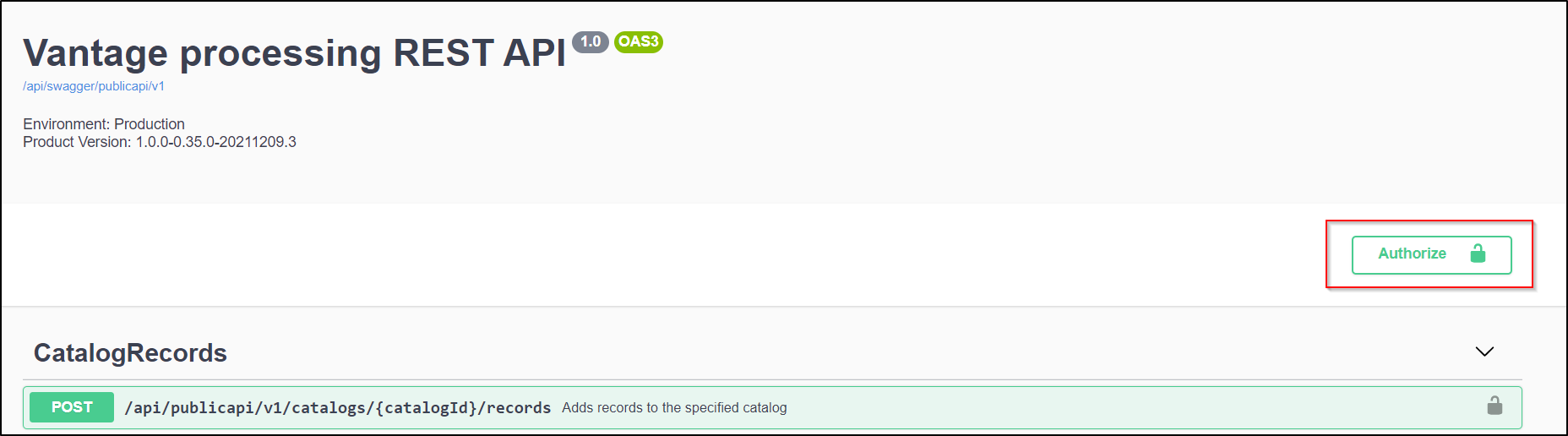
To get a first access token perform the initial authentification using the default client, one does not need to enter any passwords or client ID. The initial authentication is preconfigured. Just open a Swagger page (EU link or US link), click Authorize:

mceclip1.png

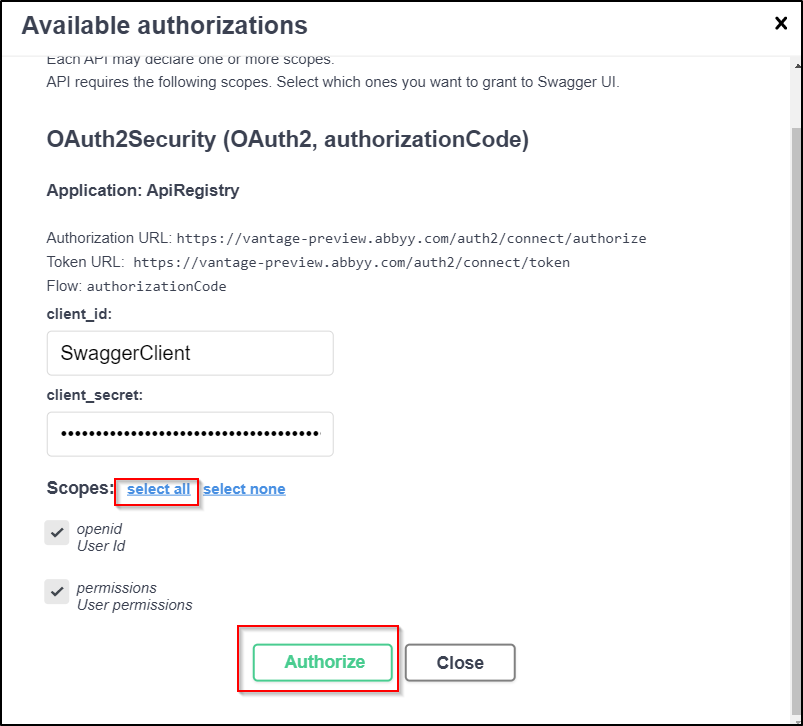
Select all scopes, and click Authorize again:

mceclip0.png

The password should be specified only for a custom client. A custom client can be created after the initial initialization.

References

EU Help: Getting a Tenant Identifier or US Help: Getting a Tenant Identifier

EU Help: Creating a Client or US Help: Creating a Client

Learn more at ABBYY […]

Barcode Recognition in ABBYY FineReader & FlexiCapture

Recognition of Barcodes in ABBYY technologies

ABBYY technology and products can read different barcode types.
The Document Analysis algorithms are able to locate and identify different barcodes on a document page, but of course it is also possible to “draw” a barcode block also via API.
Once the barcode region is defined/detected, it can be recognised. The API provides access to:
  • the coordinates
  • the characters
  • character confidence information
  • start/stop symbols of different barcode types,
    for barcodes of type Code 39 the start/stop symbol is the asterisk “*”
  • The barcode value can then be used for file naming.
A very common scenario is document separation based on barcodes.
    • This feature is implemented in FlexiCapture projects
    • With FineReader Engine, the developers can “cut” the page stream with custom code
    • Separation in FineReader Server
    • Separation in the ABBYY Scan Station (FineReader Server & FlexiCapture)

Tips for working with barcodes

Barcode recognition quality depends on:

  • the barcode print quality
  • settings used in the document scanning process
  • Placement of the barcode when it is manually added

In order for the barcodes to be recognized well, follow these recommendations:

  • A barcode must be separated from other text by a fairly wide white gap.
  • Barcode size and the width of its separate bars or dots must meet the following requirements:
    • The optimal barcode height is more than 10 millimetres. The size of a barcode should be less than A4 size.
    • Barcode height must be higher than the double height of a text line
    • For not-square barcodes, […]

Robotic Process Automation

Introducing Robotic Process Automation

RPA stands for Robotic Process Automation and it represents a new approach to business automation that helps minimize the technical hurdles required for implementing new workflows.

Robotic Process Automation of Data Entry

Traditional business process automations rely on application programming interfaces (APIs) to allow systems to exchange data. This approach has two main drawbacks:

  1. The application vendor must make those APIs available
  2. A programmer needs to write custom code to interface with them

If your software vendor does not provide an interface for consuming the data you need to automate, then you’re out of luck. And even if they do, the development costs can eliminate the ROI if the transaction volume isn’t large enough.

RPA tools avoid the API problem by interfacing directly with the application user interface just like a human would do. They use artificial intelligence and machine learning to “watch” the operator perform a task within the application then creates its own program (called a “bot”) to mimic it. This means that:

  1. Bots can do anything a human can do within the application
  2. Users can create a bot without writing code

Practically speaking, an experienced robotic process automation consultant with programming experience is required to roll out an RPA solution enterprise-wide, and most users will only be able to automate small, routine tasks without assistance. Business-critical, high-volume automations will still involve coding. But RPA dramatically reduces the implementation time and avoids the need to retrofit APIs for software applications that were not designed to support them.

How much do Robotic Process Automation systems cost?

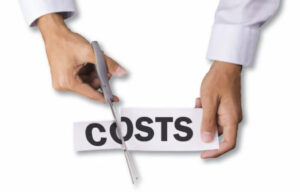
ocr automation to reduce business costs

Robotic Process Automation (RPA) tools are typically priced on a fixed, annual subscription basis calculated per deployed robot, though initial learning and […]

OCR Consulting Services

OCR Experts for Any Project

Our unique team of OCR experts are equipped to help out with OCR projects of any size or complexity. We have support specialists that can remotely configure desktop solutions in a matter of minutes and expert systems integrators with years of programming, database design, and robotic process automation experience.

Desktop OCR

Batch Document Scanning and OCRUse our online store to order desktop OCR applications and our staff will be happy to answer your setup questions via email or web chat.

Remote configuration and training services using GotoMeeting are available for a low hourly rate.

Batch Scanning & OCR Servers

Data Capture Forms OCRAutomate document scanning and digital document archival processes using zone OCR, barcode recognition, database integration and other technologies.

Small business systems and single document workflows can be setup remotely via GotoMeeting, usually in just a few hours. Chat now if we’re online or leave a message to schedule a consultation.

Data Capture and Forms Processing

Advanced data extraction solutions that can turn the most complex documents into structured data ready for use in business applications. Each member of our data capture consulting team has over 10 years experience designing and implementing advanced OCR solutions.

We are the most experienced system integrator in the US for our flagship data capture platform, ABBYY FlexiCapture. We saw its potential immediately when it was introduced and now over 15 years later it is the leading data capture solution and no team is more experienced than ours at implementing it. We are the ones that other ABBYY integrators call for their most complex implementations.

While we have designed capture solutions for all types of documents, we have particular expertise in the following […]

OCR Data Capture

What is OCR Data Capture?

document OCR process automationOCR data capture is the process of using Optical Character Recognition (OCR) technology to automatically extract text and specific data points from scanned documents for business automation. While standard OCR simply converts an image of text into a readable document, OCR data capture goes a step further by identifying, isolating, and validating key information—such as dates, totals, or account numbers—and routing that structured data directly into backend business systems to eliminate manual data entry.
Many are familiar with popular desktop OCR applications designed to convert scanned images to editable documents. When this process is applied to specific areas of the document containing data fields it’s called zone OCR. But OCR data capture software is more than just simple zone OCR. Modern applications use some or all of these technologies:

Enterprise data capture systems provide interfaces for scanning, recognition, data verification and export, as well as management and monitoring tools to track large volumes of documents and data through the workflow.

Who can benefit from OCR data capture software?

messy business information made easy with ocr data captureAny organization that collects […]

Knowledge Base

The SimpleOCR Knowledge Base contains frequently asked questions and answers, technical guides and general information on a broad range of optical character recognition, handprint recognition, data capture, PDF OCR, AP invoice scanning and zone OCR applications.

Contact Us for FREE Consultation on Your OCR Project

OCR to Database

Data is Everything. It does not matter in what field your company works, after all everything will be distilled into digits of data and accumulated in Database to be processed, stored, repurposed and reassembled again, again and again.  All organizations have database, that acts as a repository for all of their information. And you may survive with manual data entry, or using spreadsheets or just folders with documents for some time, but eventually just mare amount of Data will become overwhelming.

Luckily there are plenty of solutions for your Database. You can choose between SQL (MySQL, Access, Postgres, …) or NoSQL (Mongo, AWS, …) solutions for storing and processing Data, but there will be always an issue of how raw unprocessed digits get from images or texts into more structured form of your Database. Identifying and transferring all of this data can be a bit of a task. Misreading data or mismatching of data to fields could easily ruin your data processing system. Thus, precision of data character recognition becomes essential.

One of the solutions is to keep these processes of scanning and data transferring separate. You can use one software for character recognition and transferring data from image to PDF or text document. And then to use PDF (or text) to database converters to extract that data into your database format. The very obvious disadvantage of this approach is that it adds the whole extra step into your data processing. You will start accumulate additional errors, will add time for setting up additional conversion, will add time to data processing and will add time for inevitable error identifying and bug fixing. It may work for smaller companies, but on larger enterprise level it becomes cost prohibitive.

Another solution is OCR to Database direct approach. […]

Enterprise OCR Applications

Enterprise OCR Data Capture Software Enterprise OCR Data Capture Software

Enterprise OCR refers to applications designed with the features and scalability required for large businesses and service operations.

Speed and efficiency are the name of the game at the enterprise level so options like batch processing, multi-user and multi-server workflows, security and compliance auditing are found in these applications.

Enterprise OCR can also refer to Enterprise Site Licensing for desktop OCR applications that allow any user in your organization to install licensed OCR tools without incremental costs. Contact Us for a quote on any Site License.

Enterprise Data Capture Solutions Enterprise Constitution Class Starship
Enterprise Document Management

With the high volume of documents coming out of an enterprise OCR product, there is a need for robust Document Management applications with enhanced features that cover the stricter oversight needs of large organizations. Sorting through thousands or millions of pages can quickly turn digital documents into a quagmire without proper organization, tagging, search and workflow capabilities.

Enterprise Document Management features include:

  • Digital signatures
  • Document life cycle management
  • Version control
  • Advanced keyword searching & full-text indexing
  • Audit trails (HIPAA, Sarbanes compliance)
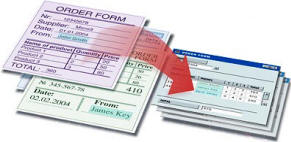
  • Cloud Based Document Management Apps Cloud Based Document Management Apps

    Email archiving

  • Workflow routing
  • Enterprise Report Processing (ERP)
  • Document access control

Our document management solutions work with any of the enterprise OCR products below to provide a secure end-to-end solution. Contact Us to see how they work together in an online demo or get a quote.

Handprint Recognition Guide

What is ICR, Handprint Recognition?

Intelligent Character Recognition (ICR) is an advanced form of Optical Character Recognition (OCR) technology specifically designed to interpret and convert hand-printed text from scanned images into digital data. While standard OCR is optimized for machine-printed fonts, ICR utilizes neural networks and advanced pattern recognition to analyze the unique variations of human handwriting. This technology allows automated data capture software to accurately read and process filled-out paper forms, applications, and handwritten notes without requiring manual data entry.
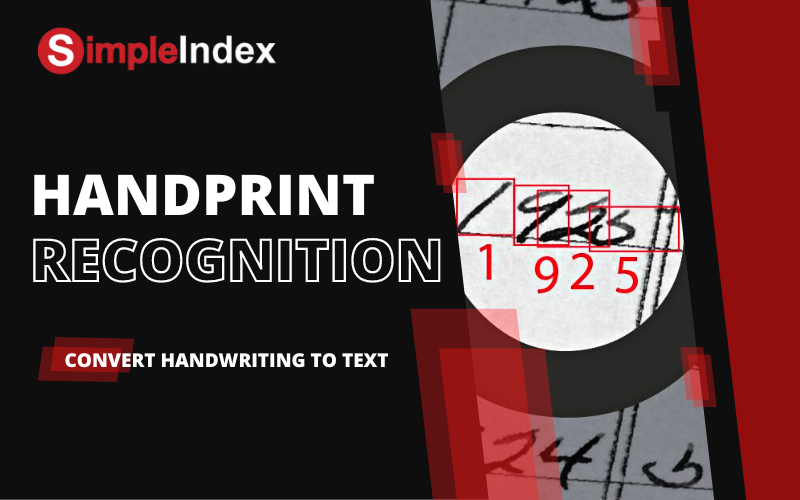

Forms Processing Software uses ICR technology to automate data entry tasks involving hand-filled surveys, applications and forms. It provides interfaces for scanning, recognition, data verification and export, as well as management and monitoring tools to track large volumes of documents and data through the workflow.

Forms Processing also includes OCR (Optical Character Recognition) technology to recognize machine printed text, and OMR (Optical Mark Recognition) for check boxes and multiple choice bubbles.

Traditional forms processing relies on constrained handwriting, where boxes on the form force the filler to write with separated, printed block characters. Modern AI technology has dramatically improved the ability to recognized unconstrained handwriting and cursive script. Hand printed notes, free-form comments blocks, non-segmented fields, historic documents, and more can now be converted to text with acceptable accuracy where these were impossible just a few years ago.

Who can benefit from handwritten recognition software?

Any organization that collects data on paper-based forms, surveys or applications on a regular basis can get a very high return on investment by automating the data entry with forms processing software.

You do need to have a significant number of forms to justify the expense, at least a hundred forms per month or more depending on how […]

Invoice Processing

What is Invoice Processing?

Invoice processing software is a specialized automated solution that uses OCR data capture technology and page layout analysis to automatically extract key data from financial invoices. By applying intelligent data extraction algorithms specifically tuned for accounting workflows, the software automatically identifies, isolates, and indexes common transactional data points such as vendor names, invoice dates, total amounts, invoice numbers, and line-item details. Because invoices are among the most common documents companies need to process, these specialized applications are pre-configured to handle various layout variations, seamlessly routing the captured data into backend ERP or accounting systems without manual data entry.

Who can benefit from Invoice Processing software?

Data Capture Forms OCRAny organization that receives a large number of vendor invoices on paper can benefit from invoice processing technology. The more data from each invoice that you are hand-keying into your accounting software the more benefit you can get from each page you automate.

Accounting firms and other companies that do outsourced accounts payable processing stand to gain the most return on investment from automation. It also has the benefit of on-shoring the data entry, providing additional security and piece of mind to your customers.

A robust OCR invoice processing solution becomes justifiable when you have over 1,000 invoices per month. When dealing with smaller volumes the potential return on investment does not justify investment in an enterprise solution. However, a simple document scanning solution to digitize and store scanned invoices can still provide many benefits.

How does it lower the cost of AP processing?

There are many benefits to OCR invoice systems when it comes to AP processing that give these systems a very high return on investment.

  • Automate data entry tasks
  • Eliminate data entry errors […]

Receipt Scanning

How does OCR work for receipts?

Receipt scanning utilizes specialized Optical Character Recognition (OCR) technology to extract key financial data from printed or digital receipts. Rather than just saving a static image, receipt OCR identifies and isolates crucial information like vendor names, transaction dates, tax totals, and line-by-line line items, instantly transforming messy paper into structured, searchable data for expense tracking.

When you’re managing your small business’ finances, filing taxes or just dealing with a results of your shopping spree, it’s necessary to know and record where your money is being spent. But receipts from your purchases may get lost in a sea of other documents and miscellaneous papers.

And when it comes to record keeping, tracking a pile of receipts can become daunting, especially if you travel often for business and need to organize them for expense tracking, or you run your own company and want to write-off all expenses you can.

If you struggle to keep track of your receipts, a receipt scanner can become incredibly useful. Some receipt scanners include online tools and apps that allow you to keep and access your receipts from anywhere, so receipts will be consolidated and you can access them whenever you need them.

At the same time, just having a mobile phone with Scanner App offer a lighter and easier alternative. Receipt Scanner Apps make it easy to scan receipts with any mobile device. Having the ability to transcribe key data and record the information without manual data entry will save you time, and best of all, you can toss those paper receipts.


The Neat app transforms your device’s camera into a powerful mobile receipt scanner that’s always at your side, making it easy to stay organized. The Neat mobile app is […]

HealthCare Claims Forms Processing

Automating Medical Forms with OCR

Perform your claims processing faster, with less errors and effort using OCR.

Once the form is scanned, our software:

  • Electronically isolates and records information provided in the different fields
  • Transfers and fills that information
  • Checks for errors and flags those errors for easy verification.
  • Automatically generates the proper organization and format of the form to meet requirements
  • Accurately submits and stores your claim

By expediting claim processing and increasing accuracy,

you can decrease the overall time it takes to process claims to ensure faster payments.

The open architecture and technology allow for flexibility

to customize and enhance system operations to specifically fit your organization’s unique requirements and easily meet changing healthcare industry standards.

In coordination with our team of experienced professionals,

we can provide the critical expertise and effective ongoing support that you need to succeed in the ever-changing healthcare industry.

Other functions and benefits include:

  • Index forms for instant searching and viewing
  • Reduce the risk of combining redundant member information
  • Customized to specifically fit your company’s requirements
  • Improve exception handling
  • Maintains both professional and institutional claim types with all required information
  • Reduce errors
  • Increase accuracy, productivity, and profitability
  • Predefined templates for fast implementation

The forms CMS 1500 (formerly HCFA 1500) and UB-04 are the most common medical forms used to submit a claim. The form CMS 1500 is the universal claim form used by non-institutional healthcare providers, such as private practices, to bill specific covered services. The form UB-04 is very similar to the CMS 1500, but it is used by institutional healthcare providers, such as hospitals, to submit claims. […]

Forms Processing

What is ICR, Survey & Forms Processing?

ICR stands for Intelligent Character Recognition and is the technology that allows software to interpret hand printed text on scanned images.

Data Capture Forms OCRForms Processing Software uses ICR technology to automate data entry tasks involving hand-filled surveys, applications and forms. It provides interfaces for scanning, recognition, data verification and export, as well as management and monitoring tools to track large volumes of documents and data through the workflow.

Forms Processing also includes OCR (Optical Character Recognition) technology to recognize machine printed text, and OMR (Optical Mark Recognition) for check boxes and multiple choice bubbles.

It is also possible to use these applications to automate data collection from PDF forms, Word documents, Excel spreadsheets, and other formats used to fill out forms electronically. Many include the ability to publish forms as paper, fillable PDF and web pages simultaneously to distribute and collect data from multiple sources into one dataset.

Who can benefit from forms processing software?

Any organization that collects data on paper-based forms, surveys or applications on a regular basis can get a very high return on investment by automating the data entry with forms processing software.

You do need to have a significant number of forms to justify the expense– at least a hundred forms per month or more depending on how much data is being captured. If the data entry task can be done in under 100 man-hours then it is not a good candidate for automation with ICR software.

Organizations that have many separate departments that collect data on forms can share the budget for forms processing software by re-using it for other projects. Your current project may not be big enough to justify the expense, but when combined with one or two others it would be.

How much do […]

Document Management

Simple Document Management SystemsDocument management covers a lot of ground, from a shared folder of scanned files to a records system with audit trails and retention rules.

Whichever one you need, the step that decides whether it works is the first one: getting paper in as searchable, indexed documents instead of flat images nobody can find.

We sell both halves. Capture and OCR software indexes documents on the way in, and document management systems store, search, share and route them. We can also add OCR to the system you already run.

Contact us for a free evaluation of your project and a live demo of the software we recommend.

Small Offices and Departments

For one department or a small business, a well-organized shared folder is often all the document management you need. Batch scanning software like SimpleIndex reads barcodes and text as it scans, then names and files each document automatically, so a shared folder or SharePoint library stays searchable without anyone typing.

Desktop document management adds a viewer, search and simple organizing on top, without the security and workflow overhead of an enterprise system.

Cloud or On-Premise

A web-based system works from any computer without installing client software. A hosted one also takes the servers and upgrades off your hands.

Both of the enterprise platforms we recommend come in on-premise and cloud versions:

Records Management for Larger Organizations

Once more than a handful of people share documents, you usually need more than storage and search:

  • Access […]

Document Scanning

Document scanning software: the whole run, not just the recognition step

Feeding paper into a scanner is the easy part. What costs money is everything around it — deciding where one document ends and the next begins, straightening and cleaning the images, reading enough of each page to name and file it, checking the result, and handing it to whatever system has to hold it. A document capture platform is software that runs that sequence over a batch, unattended, and only asks for a person when something genuinely needs one.

A batch, end to end

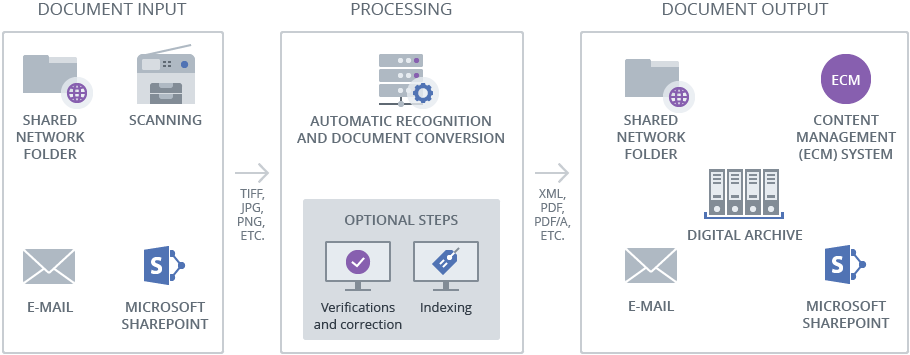
  • Scan or import. TWAIN and ISIS scanners, watched folders, email or files already on disk — existing images are treated the same as fresh paper.
  • Separate. Barcode sheets, patch codes, page counts or a recognised value tell the software where each document starts, so a stack goes through in one pass instead of one job per file.
  • Clean up. Deskew, despeckle, crop, drop blank pages and convert to bitonal, because recognition accuracy is mostly decided before the OCR engine sees anything.
  • Recognise and index. Full-page OCR makes the document searchable; zone, barcode and AI extraction pull the handful of values that become the filename, the folder path and the database record.
  • Validate. Check a value against a database or a rule, and route only the exceptions to a person rather than having someone watch every page.
  • File and export. Searchable PDF, TIFF or text into an ECM system, a shared folder, SharePoint or a line-of-business application, with the index data written alongside as CSV, XML or a database row.

Where hybrid OCR fits, and why it matters to the bill

Indexing used to mean a template for every layout and a person fixing what the template missed. The platforms below now read the page with a conventional OCR engine on your own hardware first, […]

OCR Servers

Enterprise OCR servers let you perform Optical Character Recognition on thousands of documents at a time, scaling to meet the demands of the largest document conversions.

Traditional Desktop OCR applications require a person to load the scanned document, run the OCR process and save the output files. This makes sense when you are converting individual documents, but large organizations with thousands or millions of documents need something much more automated and scalable.

OCR Server processing workflow

Typical Enterprise OCR Applications

As the cost of OCR software and hardware goes down each year and the quality goes up, full-text search is included in more and more records management applications. Typical applications include:

Features of Enterprise OCR Servers

  • OCR is performed in the background without a user interface
  • Files are imported automatically from hotfolders
  • Ability to use multiple CPUs and servers for processing
  • Management tools for remote administration
  • Web service & API integration to submit OCR jobs

What is the Best OCR Server?

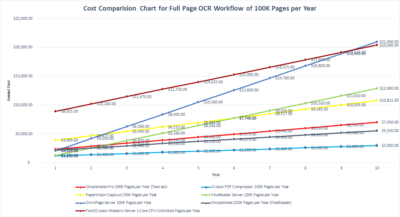
The ABBYY FineReader Server offers the best combination of features, performance and pricing. It has flexible licensing, including an unlimited CPU-based license that does not limit the number of pages processed.

Foxit PDF Compressor has the lowest entry level pricing, OmniPage OCR and unique PDF compression technology that can dramatically reduce the size of searchable PDF documents, leading to faster viewing and lowered cloud storage and bandwidth costs.

The SimpleIndex Server offers affordable unattended OCR services coupled with advanced data extraction and indexing capabilities that organizes documents automatically or saves metadata to Excel or a SQL database. It doesn’t have the scalability, API interfaces or compression technology that other OCR servers have, but you can bundle the Standard Server version with them to add […]

Batch OCR Software

Batch OCR for Full-Text Conversion & Searchable PDF

Batch OCR PDF to Text, Excel, WordThe primary purpose of Optical Character Recognition is to quickly and automatically convert scanned images of machine-printed (typed) text into actual text data that you can search through and modify.

Batch OCR software allows for the conversion of multiple files at once, usually through a hot folder or watched email inbox method that converts any files added to a particular folder.

The ability to watch a hotfolder and automatically convert documents is included in the complete versions of desktop OCR products, like FineReader Corporate, OmniPage Ultimate or ReadIRIS Corporate.

While automatic processing is available in these applications, they are not designed for true server-based processing since the application has to be running on the user’s desktop. OCR servers are designed for unattended batch OCR processing and high-volume applications that require multiple CPUs and processing workflows.

Those applications are all designed for traditional, full-page OCR conversions to text, Word, Excel, or searchable PDF documents.

Batch OCR for Data Capture

OCR Data CaptureForms Processing OCR Data Capture systems are designed to read specific data points from documents and output structured data like CSV, XML, JSON or SQL databases. SimpleIndex, FlexiCapture and PaperVision Capture all offer batch zone OCR as well as advanced features like AI-based training, invoice processing and line items.

OCR Experts At Your Service

Our OCR experts can help you find the batch OCR software that is right for your project, as well as providing remote installation, setup, training and support that’s not available for most desktop OCR applications. We can also help with enterprise implementations, custom API integrations, […]

PDF OCR

Searchable PDF OCR

Adobe Acrobat OCR to Searchable PDFCreating searchable PDF files using optical character recognition is one of the most common PDF OCR applications.
The PDF format works great with scanned documents because it allows the OCR text to be hidden in an invisible layer behind the original document image. So you see a perfect replica of the original instead of OCR text that lacks formatting and may contain artifacts and errors.

OCR PDF to Other Formats

Batch OCR PDF to Text, Excel, Word

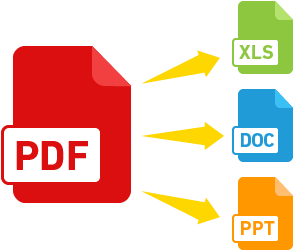
PDF OCR can also mean converting scanned PDF files to Word, Excel, text and other formats. This can be done with any desktop OCR or OCR server application. However there are several OCR applications called PDF Converters that are only designed to convert documents to searchable PDF files rather than converting PDF files to other formats. This is an important distinction to make when searching for PDF OCR software.

PDF Converters often cost less than their full-featured desktop OCR counterparts since they only offer document scanning and conversion of images to searchable PDF files. They can also include the ability to convert other file formats like Word, Excel, PowerPoint, HTML, etc. to PDF automatically. Enterprise site licensing options let you enable this capability for any user in the organization. Contact us for a quote on site licenses for any PDF OCR application.

PDF OCR Compression

PDF also offers advanced compression options like MRC, JPEG2000 and JBIG that can produce much smaller files than traditional TIFF images. Foxit PDF Compressor is even able to parse the document and apply different compression to images, text and backgrounds to reduce the size even further. This can produce huge savings in cloud storage and access […]

Applications

Why do I need OCR?

Optical Character Recognition (OCR) is a technology that converts typed, handwritten, or printed text from scanned documents and images into editable, searchable machine-readable data. Without OCR, a scanner simply takes a digital photograph of a page. Because the text in a standard image cannot be searched, copied, or modified, the data remains locked. OCR software solves this by analyzing the shapes of characters in an image and translating them into actual text that other software applications can read and process.

There is a wide variety of OCR software available. While they all share the ability to convert images of machine printed (not handwritten) text or numbers into an editable format, the various software often have different features, accuracy, prices, and language options.

You can find the various types of OCR software with a description of each below.

Users within a single department, working from home or who have a small business can simply scan their documents to a folder that is shared to everyone. In this “ad-hoc” scenario you only need some basic document scanning software to simplify and bring consistency to your filing system.

If you want to move to the next level, there are Desktop Document Management options that provide an all-in-one means for capture, storage, search and retrieval of documents. Additionally, they provide security, advanced capabilities and ease of use above that of the ad-hoc methods

And let’s not forget cloud-based options that alleviate the need to maintain storage servers or keep software up to date.

Need a simple, no frills OCR solution without spending hundreds of dollars on a professional software package? Look no further. There is a no cost, […]

2026-10-03T15:36:32-04:00Tags: , , , , , , , , , , , , , , , , , , , , , , , , , , , , , , , , , , , , , , , , , , , , , , , , , , , , , , , , , , , , , , , , , , , , , , , |
Go to Top